An AI support agent that knows your product cold.
Products that take special skills to install and maintain raise technical questions generic AI gets wrong. Graybeard gets them right — under your brand, sourced from your own documentation.
01/What
What Graybeard is.
A customer support AI agent trained on your products and embedded inside your customer support flow. It cuts ticket volume on the questions your team gets every week, answers the questions your customers could not get to before, and gives your CS director a dashboard worth taking to the boss.
Today the answer lives in a wiki nobody updates and a library of PDFs nobody opens. Here are eight reasons manufacturers retire that setup for Graybeard — each one a support call that never gets made.
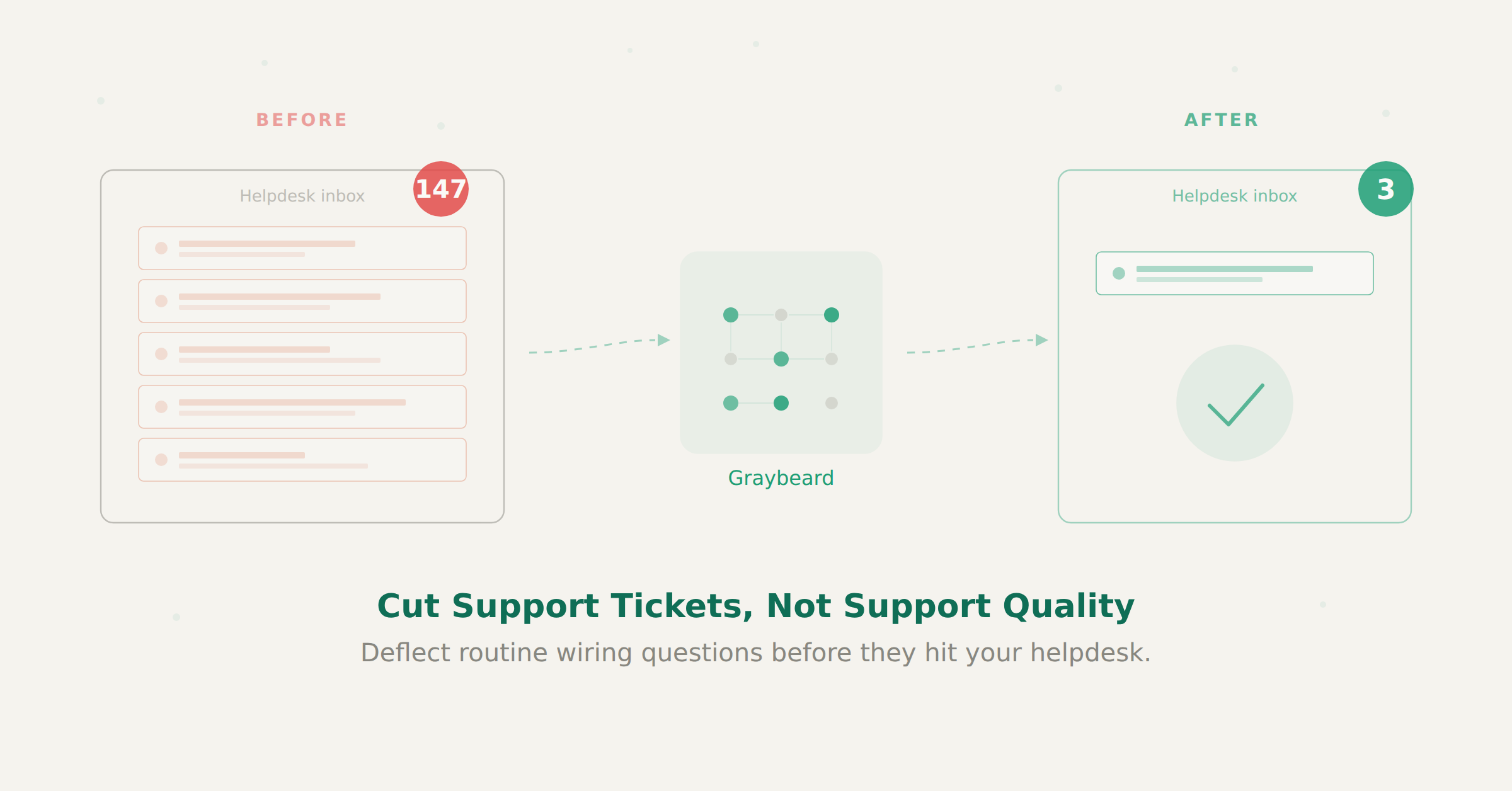

Cut support tickets at the source.
Every question Graybeard answers with a citation is a call your helpdesk did not take. Your documentation starts earning its keep instead of collecting dust.
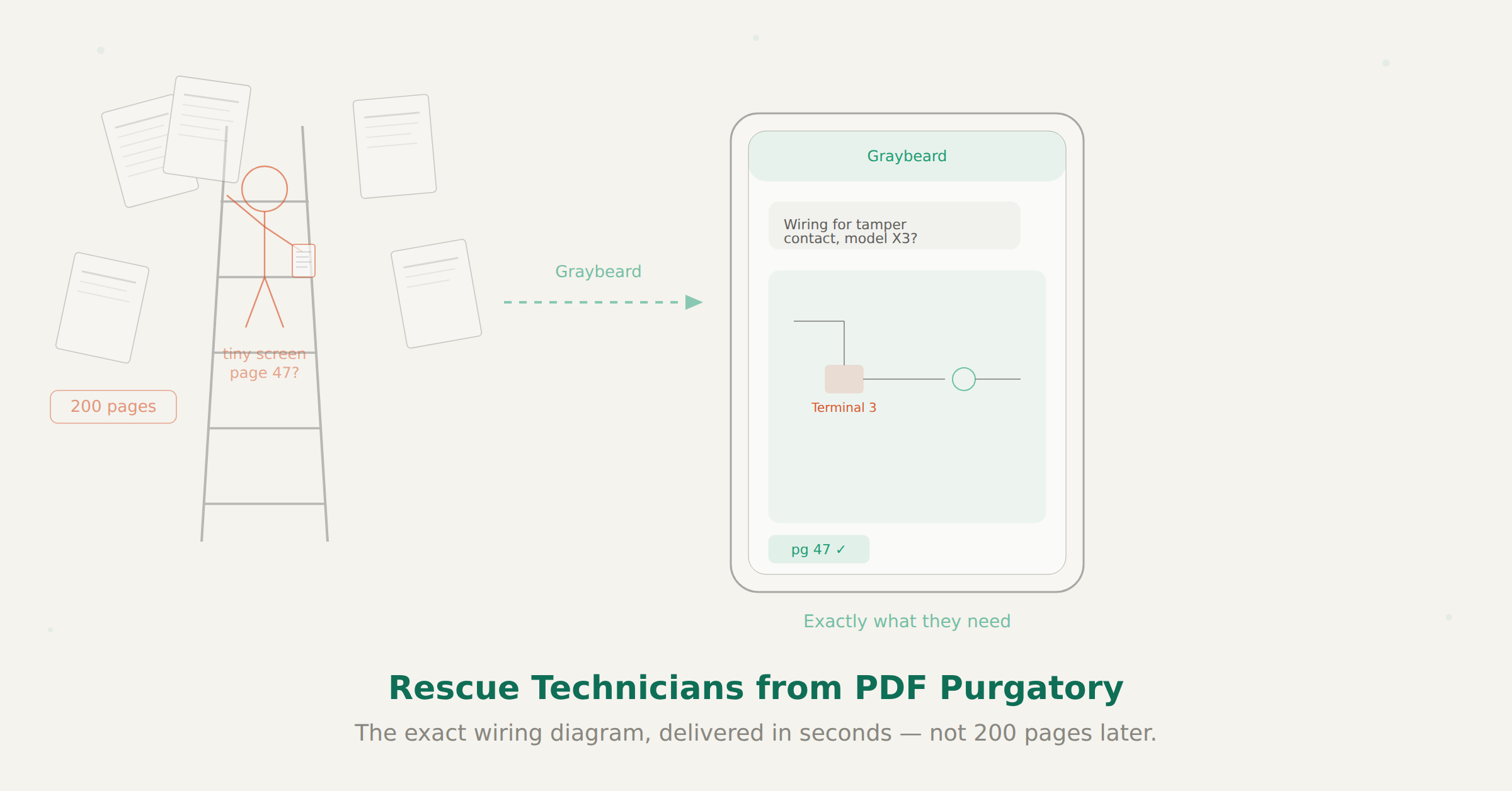

Rescue your manuals from PDF purgatory.
Technicians do not search your PDFs. They search Google, then they call you. Graybeard pulls the right page out of the right manual and hands it over in the moment.
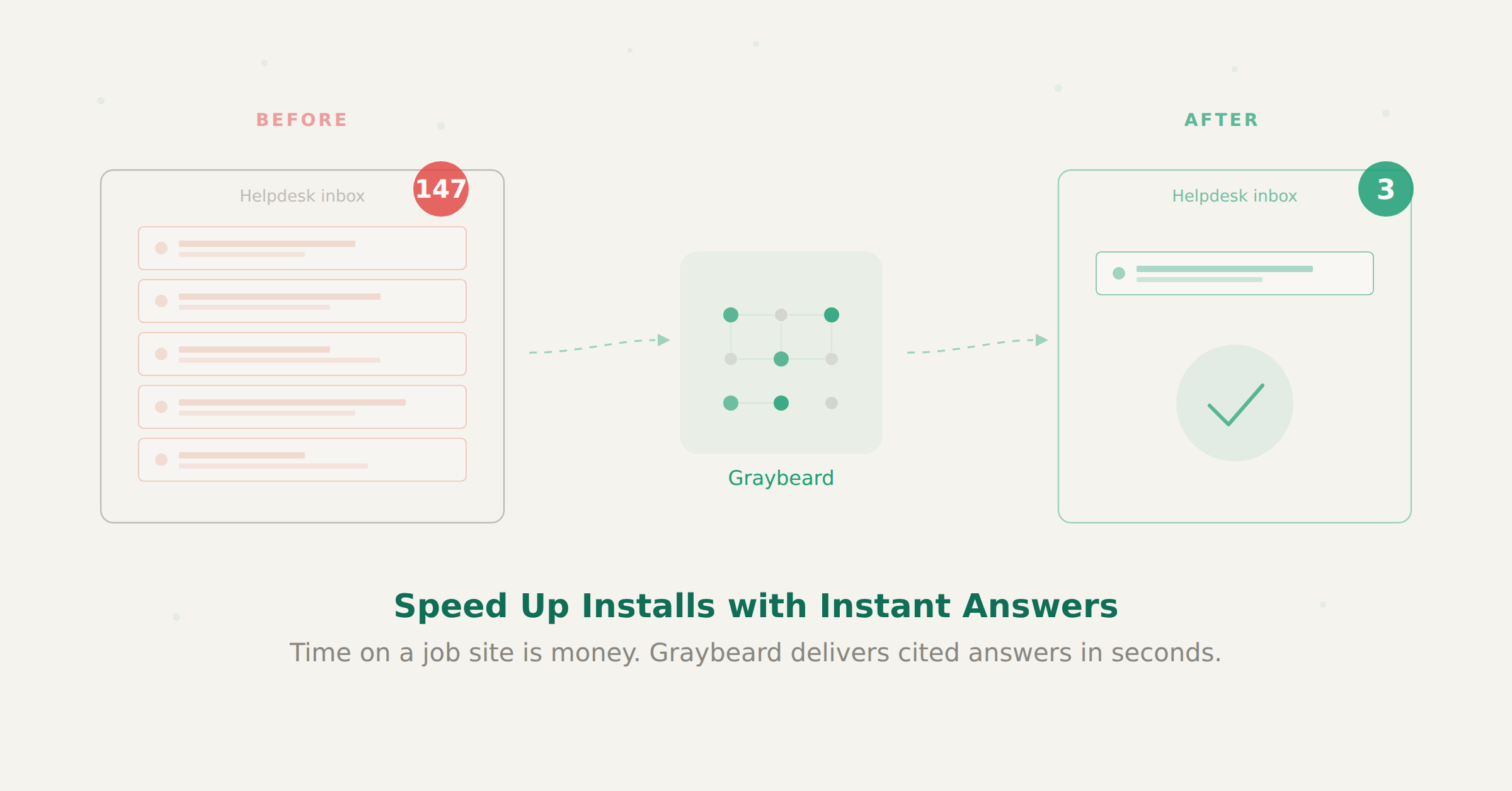

Speed up installs.
A technician who finds the wiring diagram in ten seconds finishes the install in an hour. A technician who cannot find it spends half a day. You own the difference either way.
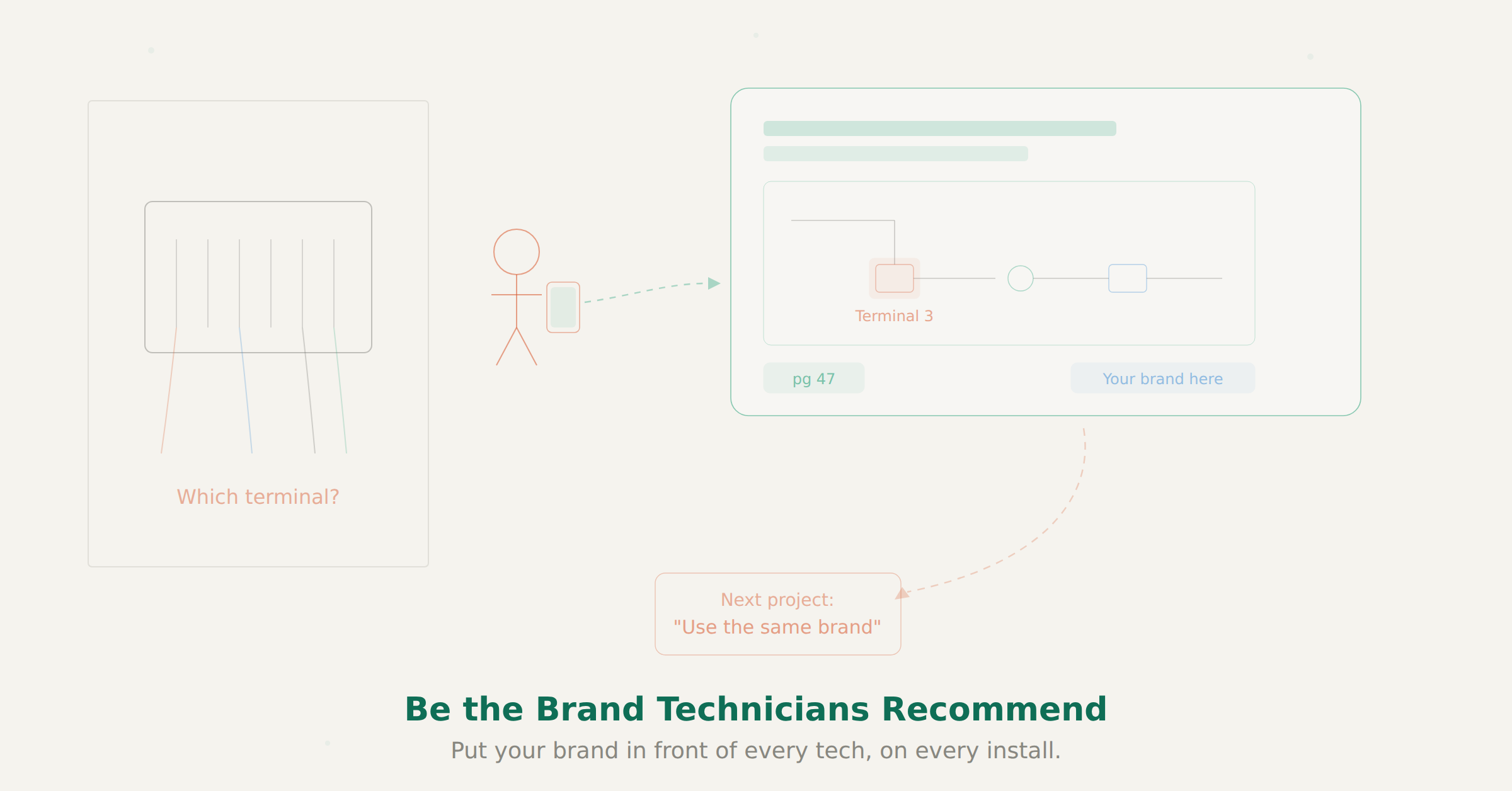
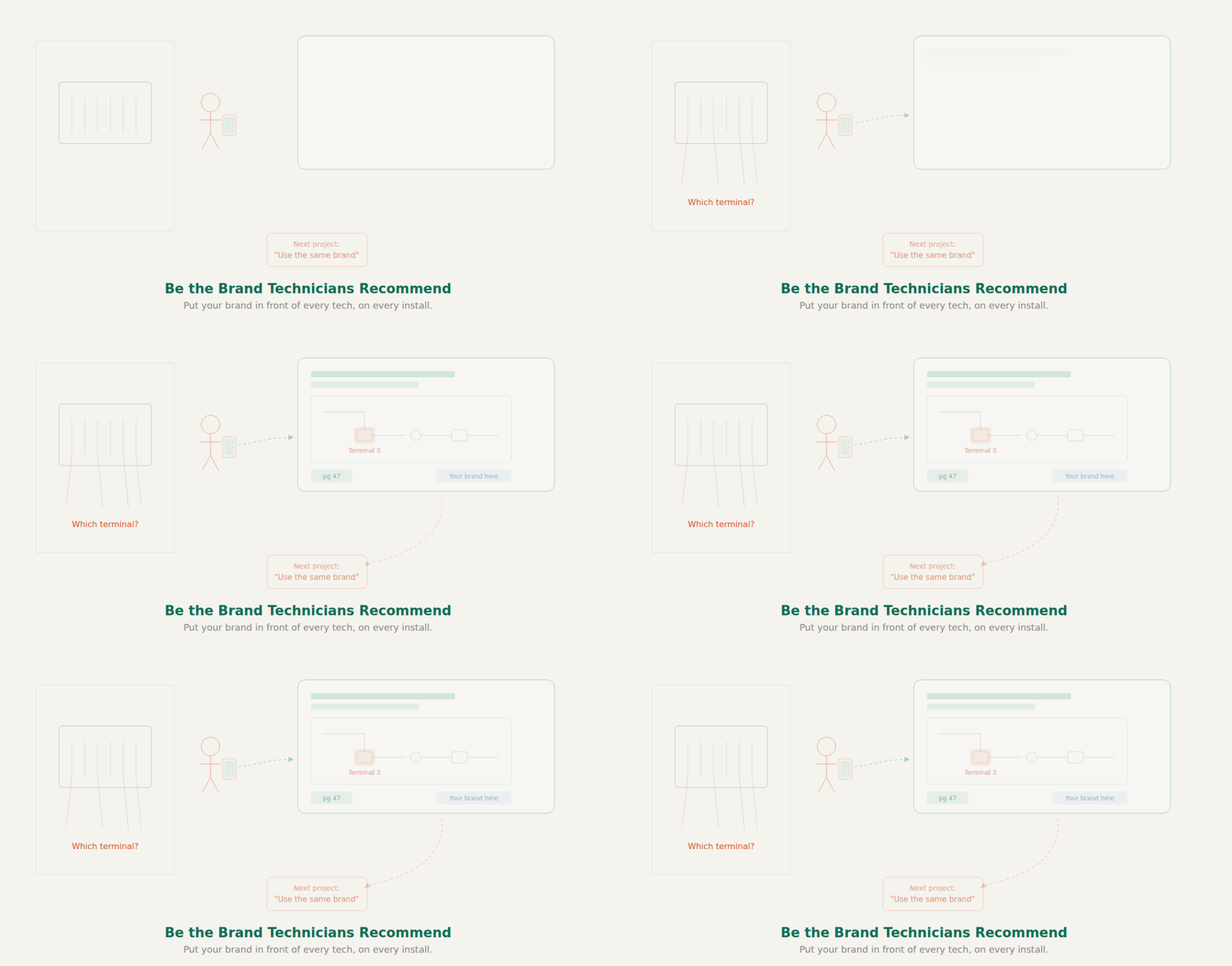
Become the brand technicians recommend.
Techs stock what they trust. They trust what they can actually use on the job. Making your docs usable is how your brand shows up in every install decision.
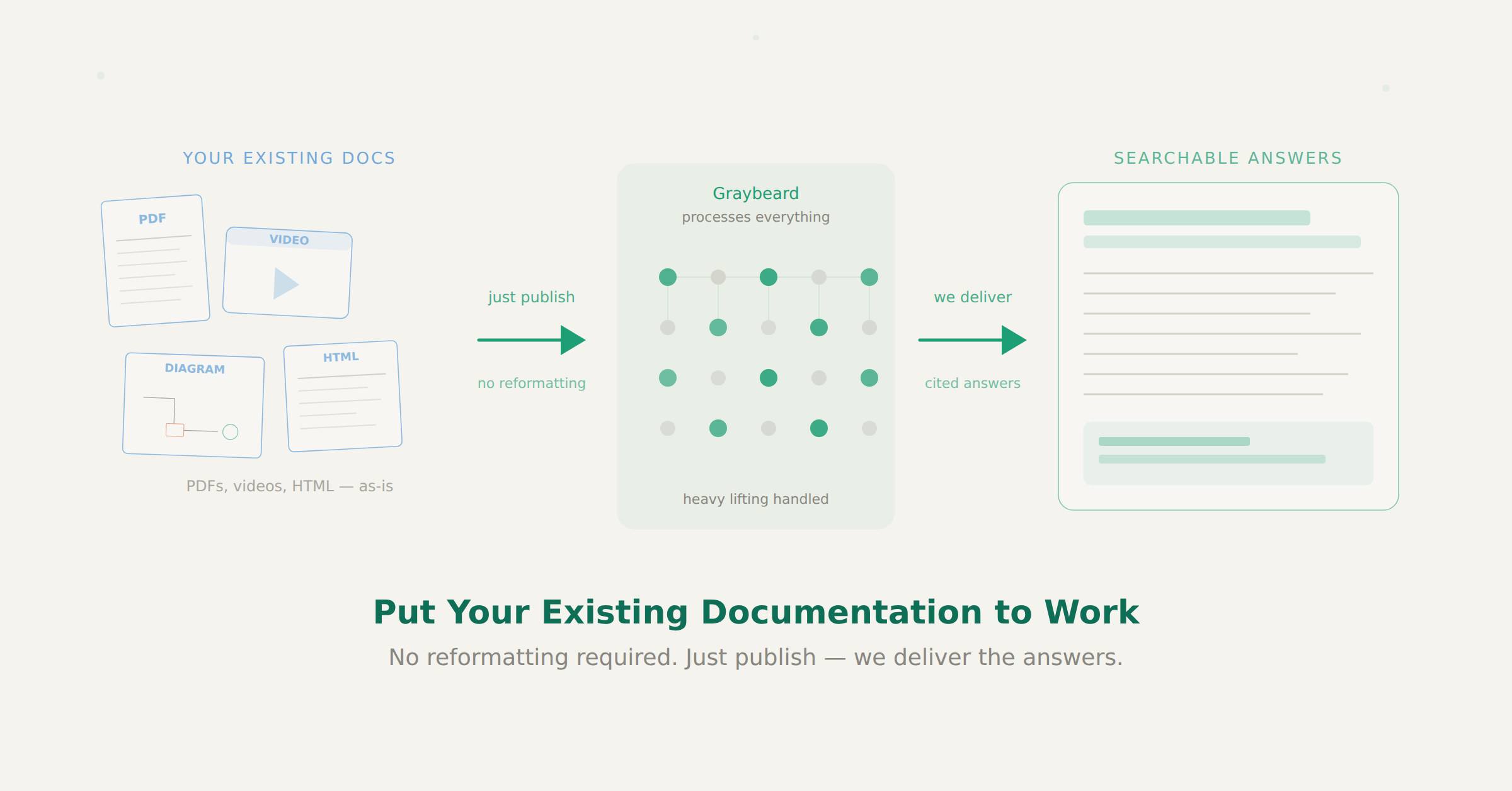

Pull from your existing systems.
Graybeard syncs from Zendesk, Salesforce Knowledge, Freshdesk, HubSpot, Confluence, or your own CMS. No content migration project. Your knowledge base stays the source of truth.
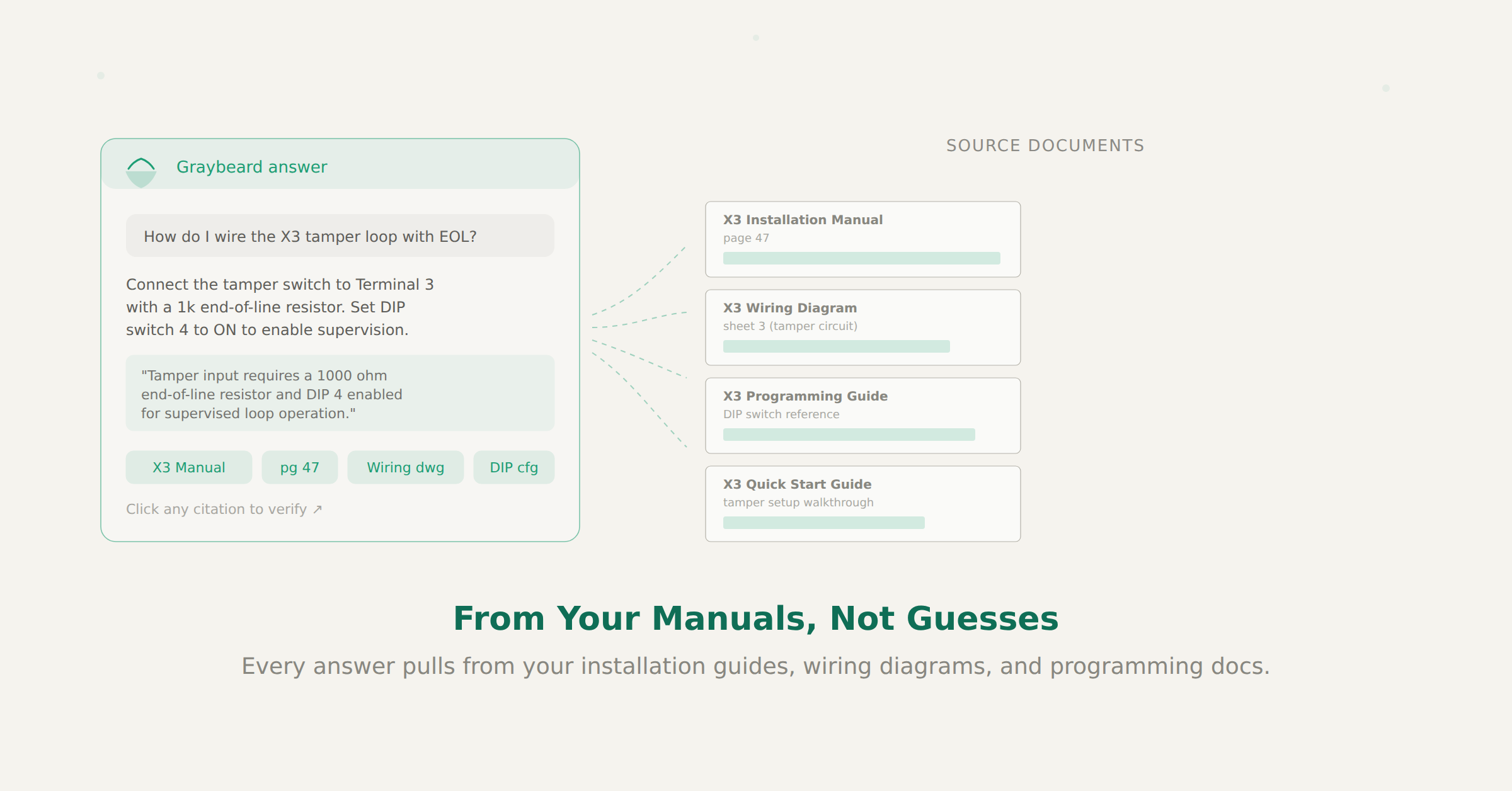

Reduce liability with cited answers.
An answer without a source is a guess. A cited answer is evidence. Graybeard tags every answer with the document and page it came from, so your field techs always know what is verified and what is not.
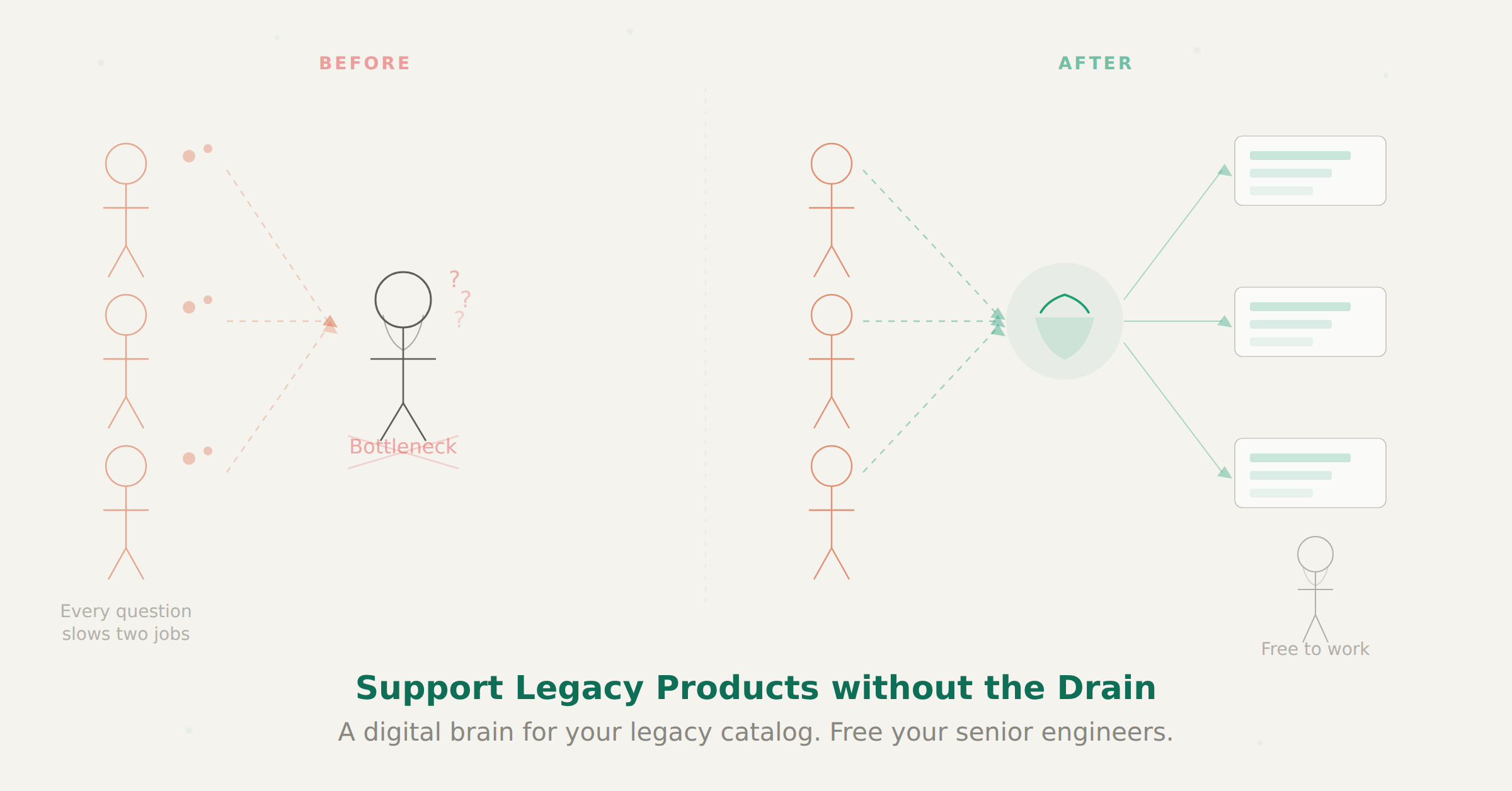
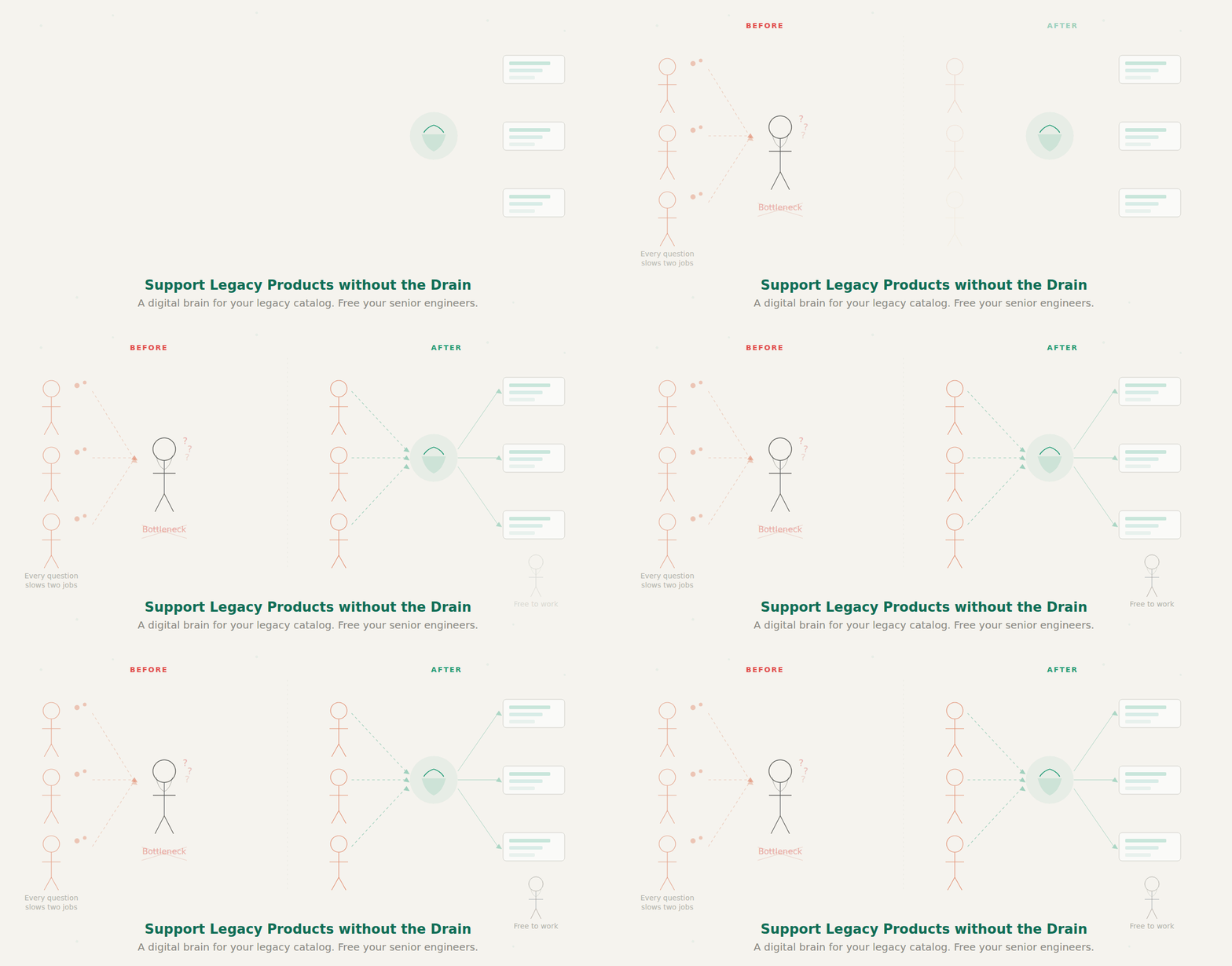
Capture knowledge before your seniors retire.
Every legacy SKU you still support lives on in PDFs nobody searches and in the heads of the people who configured them. Graybeard captures that institutional memory, so the install your retiring senior closed in 2008 still gets a cited answer in 2031.
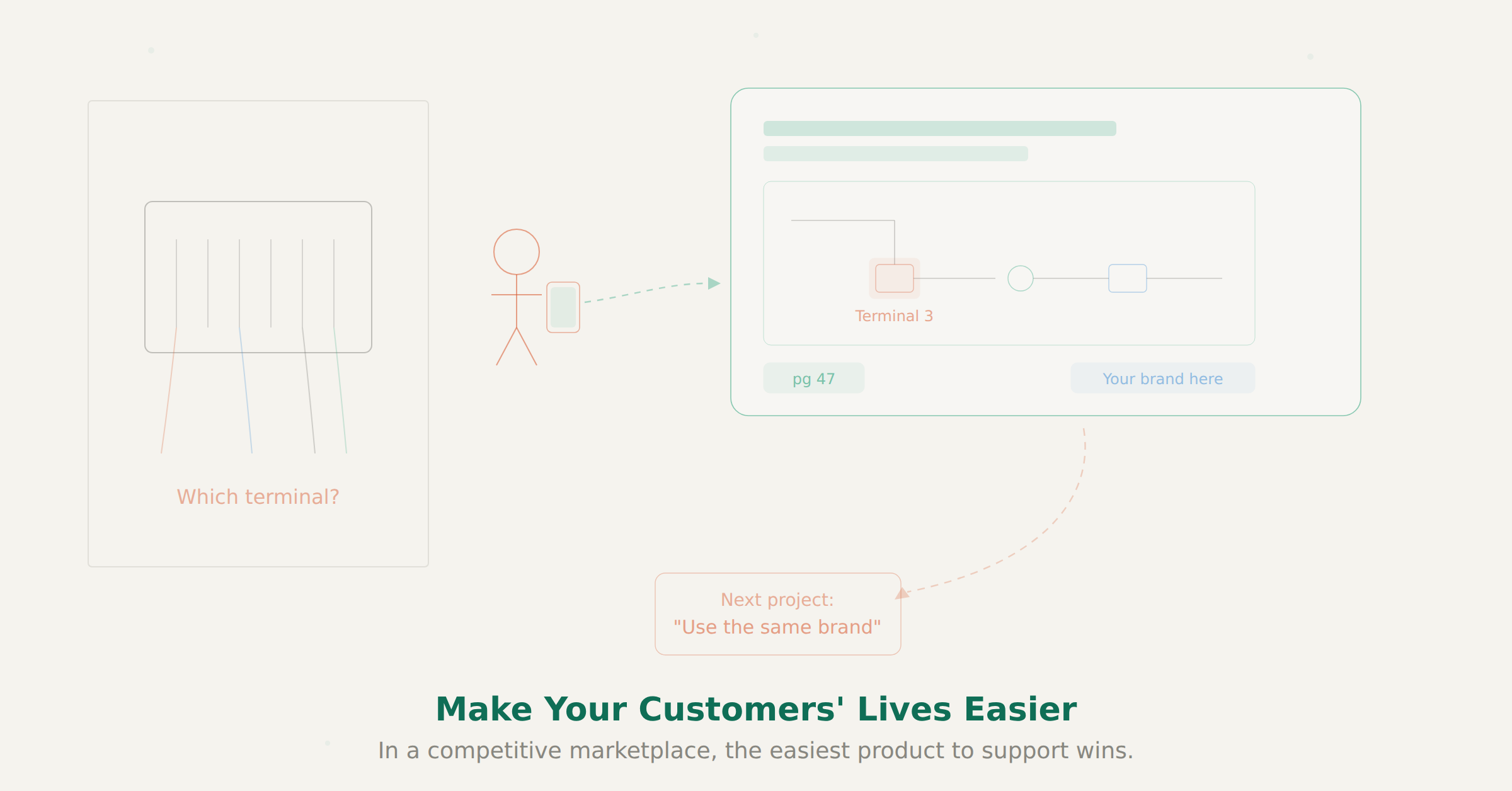
Escalate without losing context.
When a customer hits the limit of what Graybeard can answer, the chat transcript, product context, and their reach-out preference land in your existing CRM as a drafted ticket. Your CS agent picks up where the chat left off, not at zero.
That is what you get. Now the question that gets every CS director in the door: why could the existing customer support tools not deliver it.
02/Why
Why generic chatbots fail technical industries.
The technical trades that wire, install, and commission products in a building run on knowledge that does not fit in a help article. The questions are technical. The answers live across 200-page manuals, wiring diagrams, programming codes, and revision notes. Generic support tools were not built for this audience.
Generic chatbots ask “what's your issue” and suggest three help articles.
That works for “where's my refund.” It fails for “how do I wire the alarm I/O,” “what is the setpoint range on the rooftop unit,” or “which trim ring fits a flush-mount sensor.”
Your search box returns 25 articles, 8 PDFs, and 4 videos.
Your customer wanted one answer, not a reading list — so half of them call your team anyway.
Graybeard reads your technical content the way a senior installer would.
Answers in plain language. Cites the page. Links the video timestamp. Knows fail-safe from fail-secure, OSDP from Wiegand, BACnet from Modbus, a relay output from a tamper input.
That is the gap. Next: how Graybeard fills it inside the customer support stack your team already runs.
03/How
How Graybeard works.
The mechanics are simple. You send us your technical documentation and product instructional materials. We train a customer support agent on it and embed it inside your portal under your branding. Your customers ask. The support agent answers, with the page cited.
What goes in, what comes out.
Manufacturers publish documentation
Thousands of pages of installation guides, wiring diagrams, and programming manuals.
Graybeard processes and understands it
Every page, diagram, and video is processed into a searchable knowledge layer.
Customers get instant, cited answers
Ask in plain language, get the exact page with the answer.
On your portal. In your customer support flow.
Graybeard runs as a support agent embedded inside your existing customer support surface, under your own branding. Your customers see your UI, your authentication, your product taxonomy. Behind it, the support agent answers from your documentation and routes the questions that need a human to your CRM with the transcript already drafted.
Want to feel it before you commit? Use askgraybeard.com as a working preview. It is the same support agent your customers will use, running against the manufacturers already on board.
How it looks on your brand.
The Axis Graybeard.
How do I wire the tamper switch on the AXIS A1210 door controller?
Powered by Graybeard
The tamper switch connects to terminals 9 (TAMPER+) and 10 (TAMPER-) on the main I/O block. Use 22 AWG minimum. The switch should be normally closed so that opening the enclosure triggers the alarm.
AXIS A1210 Installation Guide, page 18Connected to the tools your team already runs.
Graybeard slots into your existing customer support stack instead of asking your team to learn a new one. Content flows in. Escalations flow out. The CS director sees the closed loop.
Near-real-time sync from your existing systems.
Graybeard pulls content automatically from Zendesk, Salesforce Knowledge, Freshdesk, HubSpot Knowledge Base, Confluence, or your own CMS. When your team edits an article, the change flows into Graybeard. No content migration project. Your knowledge base stays the source of truth.
Escalation that does not lose context.
When the customer wants a human, one click hands off the full chat transcript, the unresolved question, the product context, and their preferred reach-out method to your CRM as a drafted ticket. The CS agent who picks it up gets a 30-second readable summary, not a raw transcript. The customer never explains their problem twice.
Closed-loop insight back to your team.
Every conversation feeds the CS director's monthly dashboard. Deflection rate. Most common questions. Where escalations happen most. Content gaps Graybeard found in your documentation. It is a report your director can take to the boss without building a slide deck from scratch.
Embed it on your portal. Train it on your products. The next question every CS director asks: is this built for us.
04/Who
Who Graybeard is built for.
Two audiences, one product. The CS director buys it. The customer in the field uses it. Both have to win.
The buyer
Customer success and support directors.
You run a CS or support team of 5 to 50 inside a product manufacturer. Your team takes the same technical calls every week. Your wiki is buried in PDFs your customers cannot use. You want to scale coverage without scaling headcount, and you do not have a six-month engineering project in you.
Graybeard ships in weeks. You bring the source material; we bring the support agent and run the quality. Your dashboard shows deflection, top questions, and where your docs have gaps, month over month.
The end user
Field technicians, installers, facility managers.
Your customers are on a ladder, in a mechanical room, or standing in front of a panel that does not match the spec sheet. They have a technical question and the documentation to answer it is on page 47 of a 200-page manual on a server they cannot reach.
Graybeard answers in plain language, cites the page, and links the video timestamp. The thirty-second question takes thirty seconds. The senior tech stays on their own job.
Industries Graybeard is built for.
The product categories change. The pattern is the same: technical equipment that goes into a building, documented across hundreds of pages your customers cannot navigate alone.
- Access control
- Fire alarm
- Life safety
- HVAC controls
- Building automation
- Elevators
- Lighting
- Industrial sensors
- Intrusion
- Video surveillance
Graybeard works best when…
- Product manufacturers in the construction industry whose customers install, configure, or operate technical hardware.
- Support teams that can't hire fast enough to keep up with the queue.
- Companies whose customers are technicians, installers, or facility managers, not consumers asking where their package is.
- Organizations with existing documentation that is hard for customers to actually use.
That is who. Now: what it costs to put your support agent in front of them.
05/Price
What it costs.
There is no subscription. No seat fees. No minimum spend. You pay for the products on Graybeard and the questions your customers ask. Three line items. That is the whole bill.
Processing.
A one-time charge to ingest each product's documentation. Sample rate $10 per product.* Your first product is processed free.
Storage.
A monthly charge per gigabyte of indexed content. Sample rate $5.00 per GB per month.* Scales linearly, no tier cliffs.
Queries.
Sample rate 2 cents per query.* Same flat rate whether the question comes from your embedded support agent or from a customer trying the working preview at askgraybeard.com.
Price estimator.
Use the sliders to size it up for your catalogue. Left slider: how many products you put on Graybeard. Right slider: monthly query volume your content answers. The cost block shows what you invest. The ROI block below it shows what that investment returns.
Cost estimator
- Processing (one-time)
- $490.00
- Storage (monthly)
- $14.65
- Queries (monthly)
- $20.00
- First-year total
- $905.78
- Monthly after year one
- $34.65
ROI estimator
- Questions answered
- 1,000 /mo
- Support calls deflected
- 300 /mo
- Estimated return (monthly)
- $5,400
- Estimated return (annual)
- $64,800
How we estimate this: we assume 30% of the questions Graybeard answers from your content would have otherwise generated a support call, and that the average loaded cost of one support call is $18. Multiply the two and you get the dollars you did not spend on the phone this month.
Assumptions used in both estimators: 3 documents per product, 20 MB per document, processing at $10 per product (first product free), storage at $5 per GB per month, queries at 2 cents per query, 30% deflection rate, $18 average cost per deflected call. Talk to us to tune any of these for your catalogue.
* Sample pricing. Actual rates depend on content type, usage patterns, and engagement scope. Talk to us for a quote tailored to your catalogue.
Nothing to renegotiate. Nothing committed. One conversation tells us the rest.
06/Get started
Ready to give your customers a support agent that knows your products.
One conversation tells us what your customers ask most, what is buried in your manuals today, and how fast we can have your support agent live.